LS 6 — The ghost of the Ionian Sea, sunk in 1943
Photo gallery, Shipwrecks, Then and Now, WW2, WW2 in Greece, WW2 WrecksA rare Kriegsmarine fast attack vessel lost for eight decades in the depths of Greece
Written by: Marinos Giourgas
Historical Research: George Karelas
Underwater Images: Vasilis Spyropoulos
- The scope
Locating the wreck of a German Kriegsmarine torpedo boat in Greek waters is an exceptionally rare find. During the Second World War, German naval forces operating in the Ionian and Aegean Seas relied primarily on vessels that had either been requisitioned locally or transferred from the Black Sea.
The significance of this discovery is even greater because the wreck belongs to an extremely rare class of light fast attack crafts. Based on the historical evidence currently available, it is believed to be the only surviving example of its type anywhere in the world.
The manner in which the vessel sank, combined with its distinctive construction, helped preserve it in an almost intact condition beneath the waters of the Ionian Sea. Once considered a proud asset of the German naval war machine, the craft was lost in 1943 and was positively identified on 1 August 2026. Its discovery and ongoing study are already providing valuable new insights into the historical record.
- The Beginning of the Search
The journey that led to the discovery of LS6 began in 2013 with a single conversation. Our friend and collaborator, Vasilis Mentogiannis of the UFR team, relayed information he had received from renowned German historian Peter Schenck. While researching the German wartime archives in Freiburg, Schenck had uncovered a remarkable record: the loss of an important Kriegsmarine vessel somewhere in the Ionian Sea. The vessel was the LS6, an experimental light fast attack craft that represented some of the most advanced naval engineering of its time. Built for speed and special operations, it had been deployed to Greece during the Second World War. According to the German archives, LS6 departed the port of Corfu bound for Piraeus. On 29 September 1943, while under tow, it sank off the coast of Preveza.
The archival report contained two crucial pieces of information: an approximate position of the wreck and an estimated depth of more than ninety meters.
As our historical researcher George Karela recalls:
> “The fact that the vessel had been built from aluminium to reduce its weight, combined with the unusual circumstances of its loss while under tow, immediately convinced me that this was an extraordinary target for both historical investigation and technical diving. I shared the information with Dimitris Giannoulatos from Lefkada, who, after persistent effort, located a sonar target at a depth of ninety-six meters, exactly within the search area identified by Peter Schenck.”
The discovery of a sonar contact, however, was only the beginning.
Was it truly a shipwreck? And if so, could it really be the long-lost LS6?
There was only one way to find the answer.
The sea would reveal the truth.
The challenge of planning and carrying out the expedition was undertaken by the AegeanTec team, whose dive would determine whether decades of history had finally resurfaced from the depths of the Ionian Sea.
- The Dive
Together with our underwater photographer, Vasilis Spyropoulos, we completed the final preparations for the expedition and departed from our base in Athens, heading west towards Lefkada.
The mission was clear: to confirm whether the sonar target provided by Dimitris Giannoulatos was indeed a shipwreck—and, more importantly, whether it was the vessel we had been searching for.
On the first day, using a boat chartered from Lefkada, we returned to the coordinates, confirmed the position and depth of the target, and prepared for the dive that would take place the following day.
With precise boat handling, we secured the descent line as close as possible to the target and began our preparations. For this expedition, we used closed-circuit rebreathers, allowing us the extended bottom time required for a deep exploration at 95 meters.
The descent began.
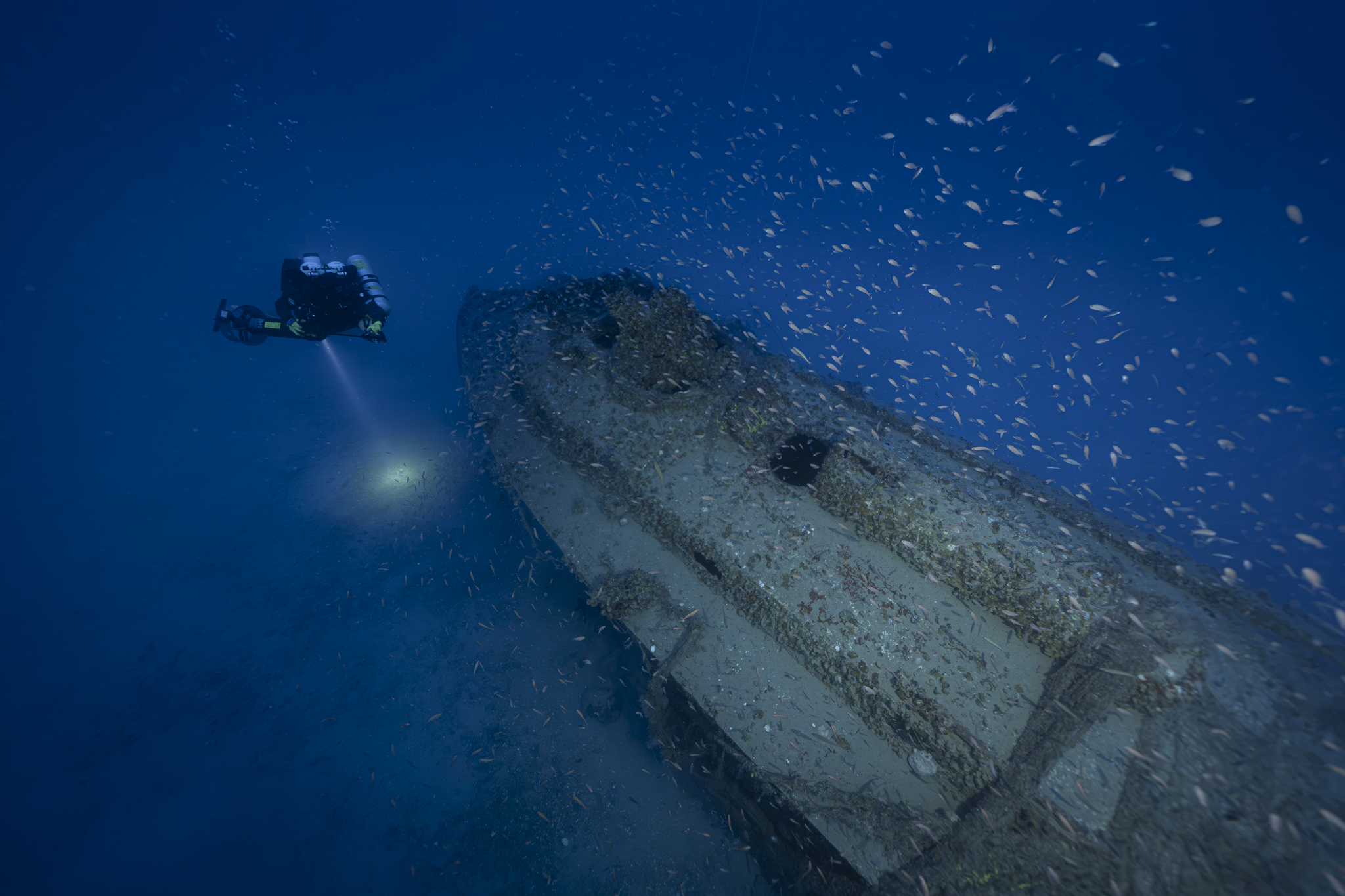
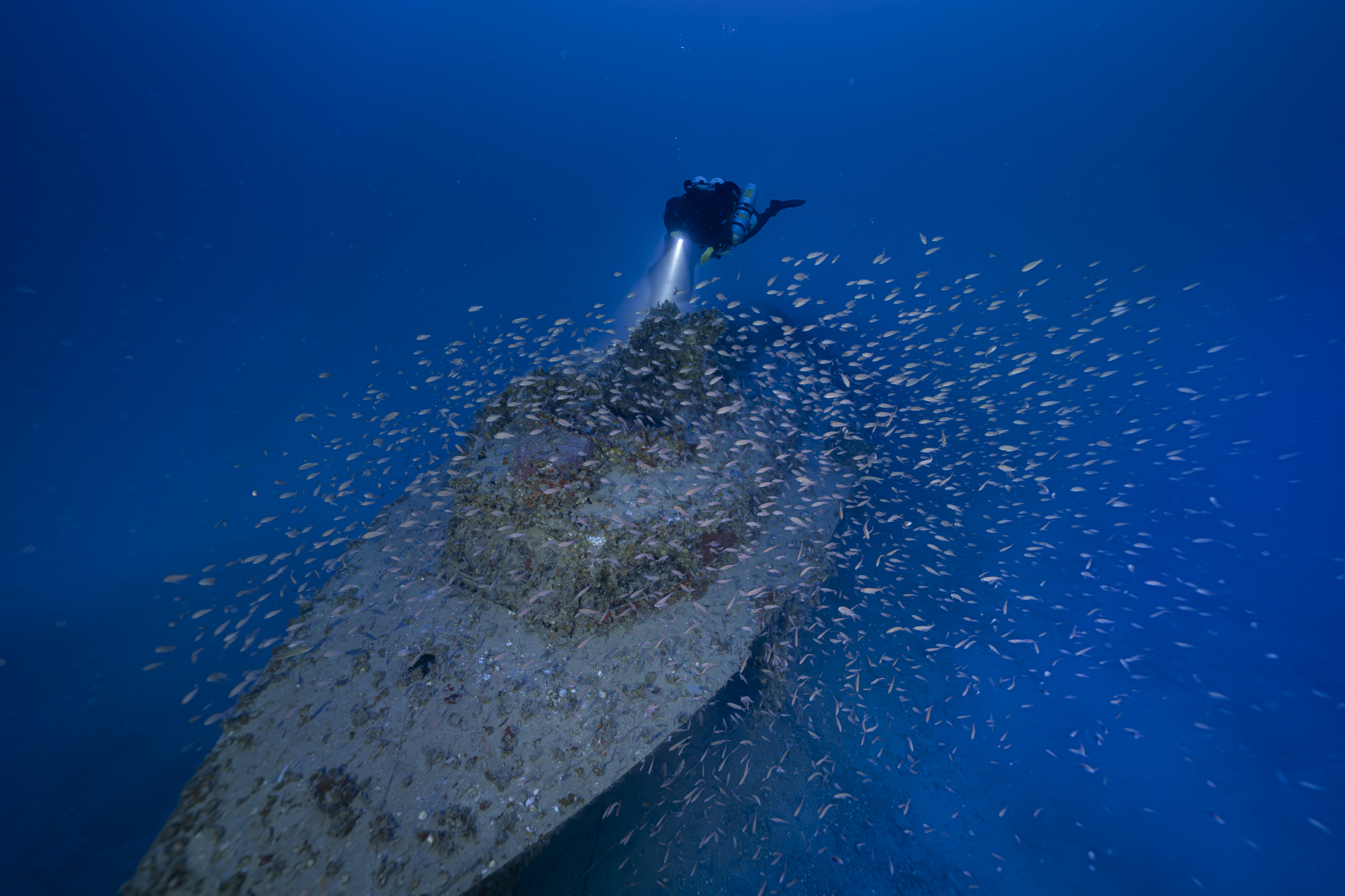
After approximately three and a half minutes, a shape slowly emerged from the blue. Through the veil of water, the first section of the small vessel’s superstructure appeared—the remains of a craft that had rested silently on the seabed of the Ionian Sea for 83 years.
At a depth of 95 meters, time is precious. There is no room for hesitation. We immediately began the carefully rehearsed choreography of positioning our cameras and preparing the visual documentation that would reveal the wreck and allow it to tell its story.
The first impression was unforgettable.
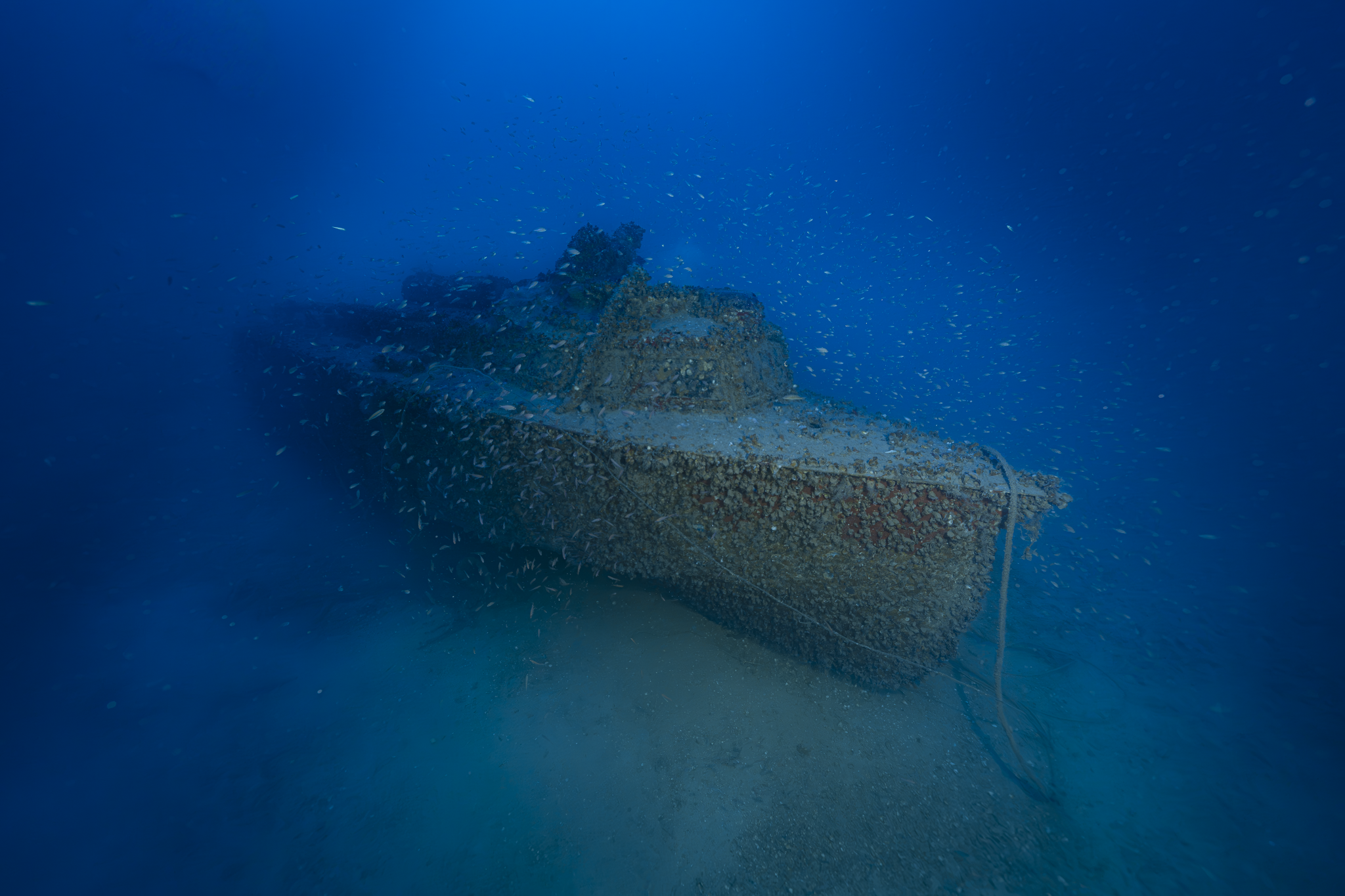
Before us stood the perfectly preserved silhouette of a small fast craft, resting upright on the seabed as if ready to begin its next mission. After more than eight decades beneath the surface, the vessel had become part of its environment. Marine growth covered its structure, transforming it into an artificial reef on the sandy floor of the Ionian Sea.
The distinctive stern doors, the compact dimensions—appearing no longer than fifteen meters from a diver’s perspective—the shape of the hull, the rectangular structure positioned on the center of the deck, and the twin engines located amidships for optimal weight distribution all began to reveal its identity.
Through a camera carefully passed inside the engine room hatch, we recorded the unmistakable shape of the Jumo engines. The evidence was becoming overwhelming.
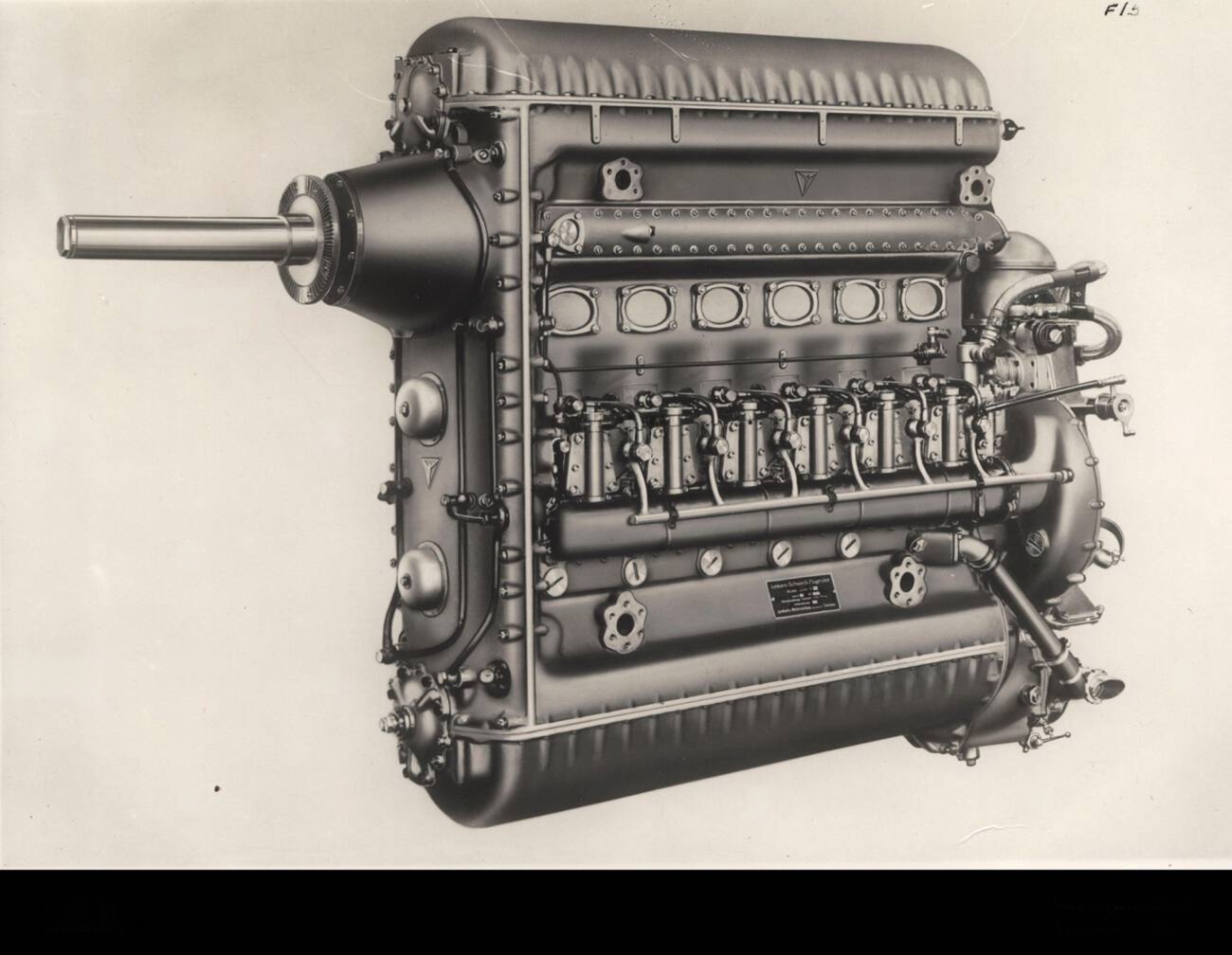
This was a Leichte Schnellboot of the Kriegsmarine.
But which one?
We needed the final piece of the puzzle—the evidence that would connect this wreck with Peter Schenck’s archival information about a vessel lost while under tow.
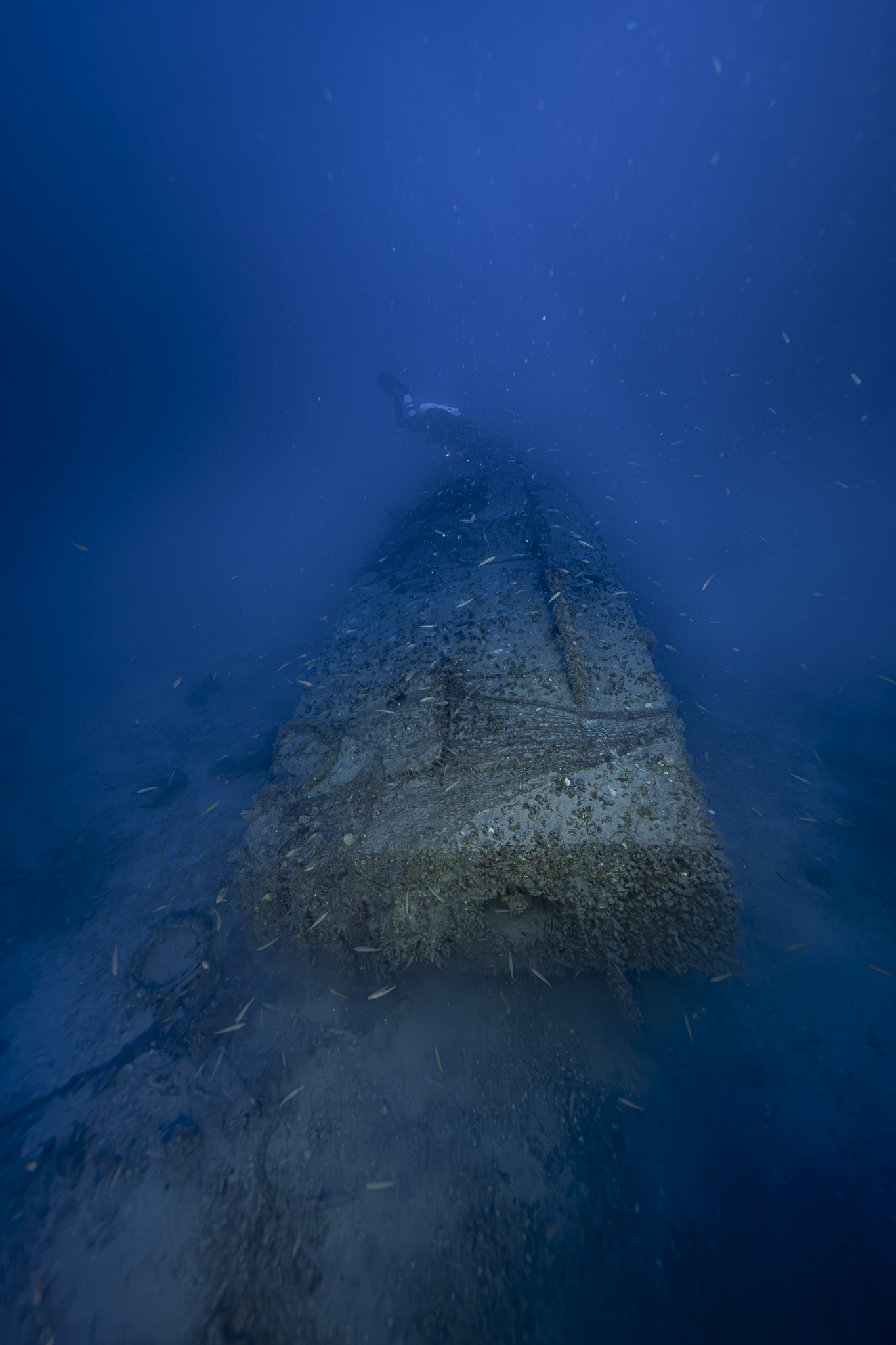
Using underwater scooters, we travelled towards the bow. There, we observed and documented damage to the hull near the engine room, most likely caused by nearby bomb explosions. Then, another crucial detail emerged: at the bow, we discovered the remains of a towing line, with the remaining section lying forward and to the starboard side on the sandy seabed.
The clues were now in our hands.
They would allow our team member and researcher, George Karelas, to continue the historical investigation and determine whether this was indeed LS6, the vessel that disappeared in September 1943.
With the hope that we had uncovered a significant discovery—another remarkable Second World War wreck added to the historical wealth hidden beneath the Greek seas—we began our ascent.
During the planned decompression stops, we remained cautiously optimistic. Deep below us was a remarkably preserved and exceptionally rare German naval vessel, waiting patiently for 83 years.
Waiting for someone to finally hear its story.
- LS 6 — Revealing the Identity of the Wreck
The thoughts that accompanied us during our ascent were soon confirmed.
After extensive research by George Karelas, we finally had the answer.
We had found LS 6!
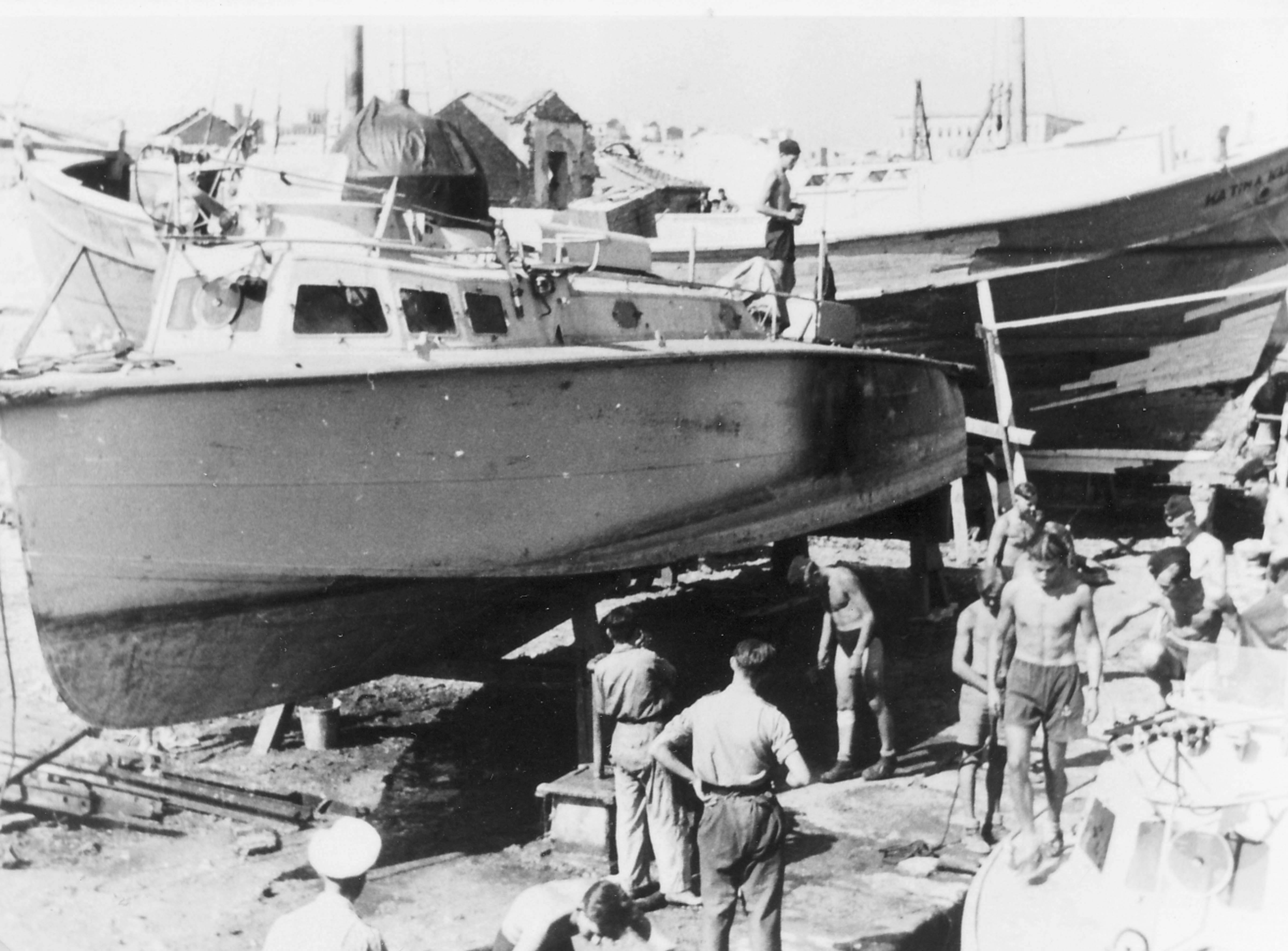
This remarkable vessel, a Leichte Schnellboot (LS) of the Kriegsmarine, was transferred to Greece in the autumn of 1943 together with its sister ship, LS 5. Measuring only 12.5 meters in length, these exceptionally compact vessels were too small to be transported by sea from Germany to the Mediterranean. Instead, they were moved entirely overland, by rail and road, using specially designed platforms and towing vehicles.
This unusual method of transport was necessary because German naval vessels could not freely pass through the Strait of Gibraltar, which was firmly controlled by the Allied forces.
Upon their arrival in Greece, LS 5 and LS 6 were assigned to the 21st Schnellboot Flotilla (21. Schnellboot-Flottille), established in September 1943 to operate in the Aegean Sea.
Their primary mission was to hunt Allied submarines operating in the narrow waters of the Aegean and Ionian Seas, locate them, and attack them using depth charges.
However, the specialized sonar detection equipment originally intended for these missions was ultimately sent to the Black Sea together with other naval units. Without this essential anti-submarine capability, the two vessels never fulfilled their intended role. Instead, they were mainly used as fast reconnaissance craft and as transport vessels for senior officers.
Despite their small size, the LS-class vessels represented a unique and innovative approach to naval warfare. Their design allowed for an unusual method of torpedo deployment. Originally conceived as small torpedo boats, their configuration placed the engines and the majority of their weight amidships and towards the stern. This left no space for conventional forward-facing torpedo tubes.
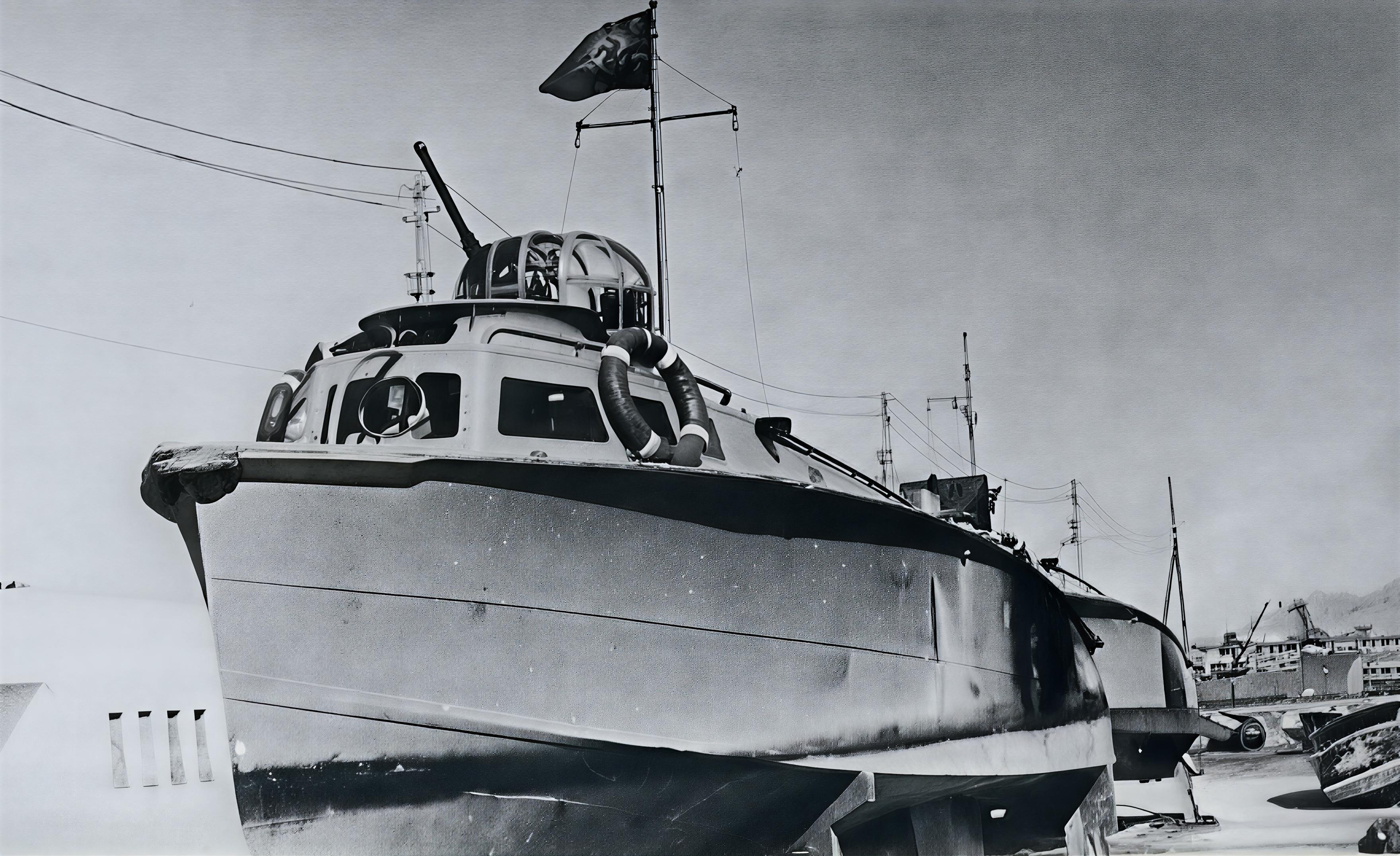
To overcome this limitation, the torpedoes were housed in special tubes positioned on either side of the engines and launched backwards in a unique stern-firing arrangement.
During an attack, the commander did not aim the bow towards the enemy. Instead, the vessel approached, turned its stern towards the target, launched its torpedoes, and immediately accelerated away at its maximum speed of 37 knots—avoiding the dangerous manoeuvre of turning 180 degrees under enemy fire.
However, by the time LS 5 and LS 6 reached Greece, their role had changed. Under orders from the German Naval High Command (OKM), they were equipped with aviation-derived Junkers Jumo 205 diesel engines and modified for anti-submarine operations, carrying depth charges.
As a result, the vessels did not carry their original stern torpedo tubes. Instead, the stern section housed a depth-charge release mechanism, with the charges stored internally on rails.
Their operational history in the Aegean was brief and tragic.
LS 5 was completely destroyed in October 1943 during the fierce fighting of the Dodecanese campaign, following an Allied air attack near Kos.
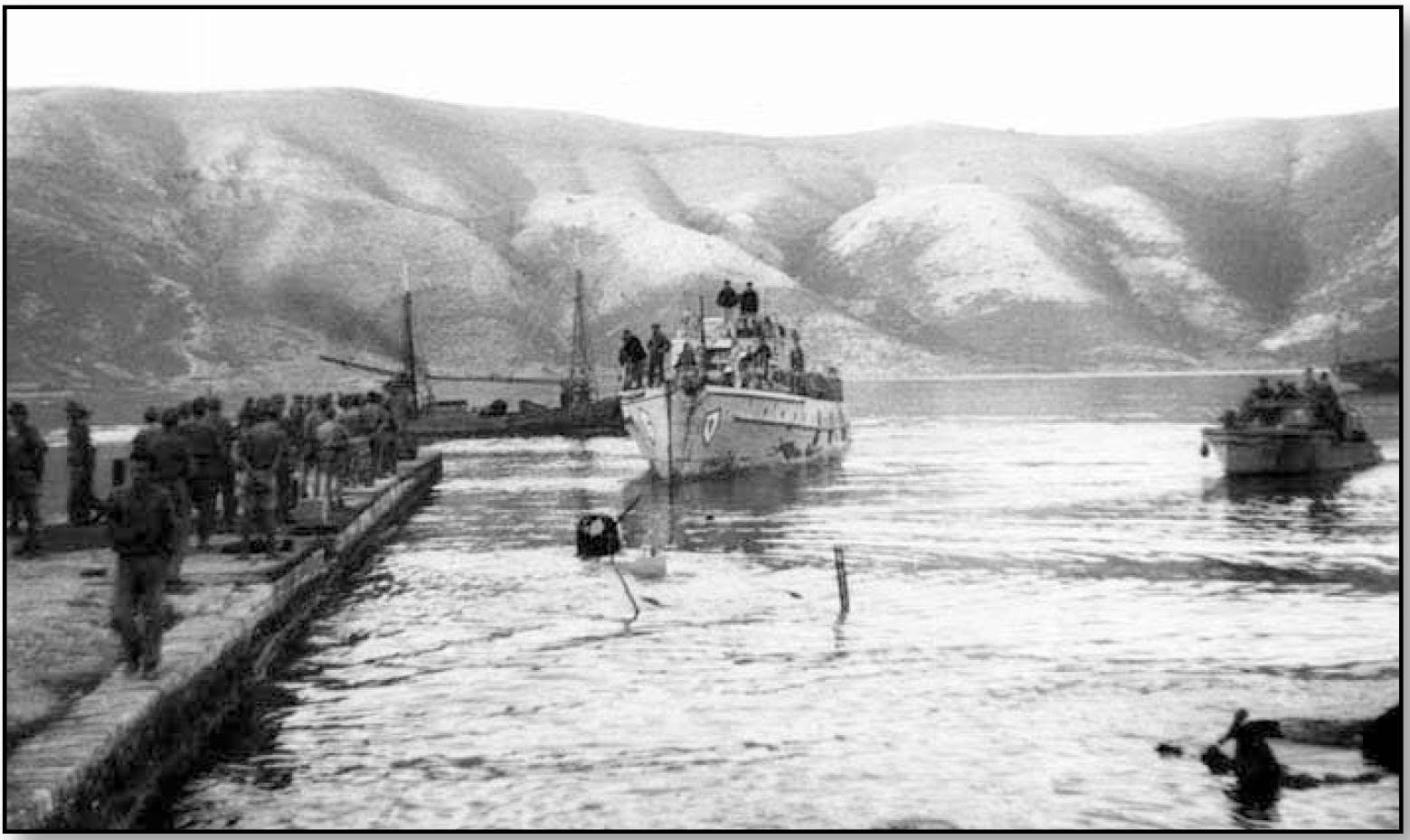
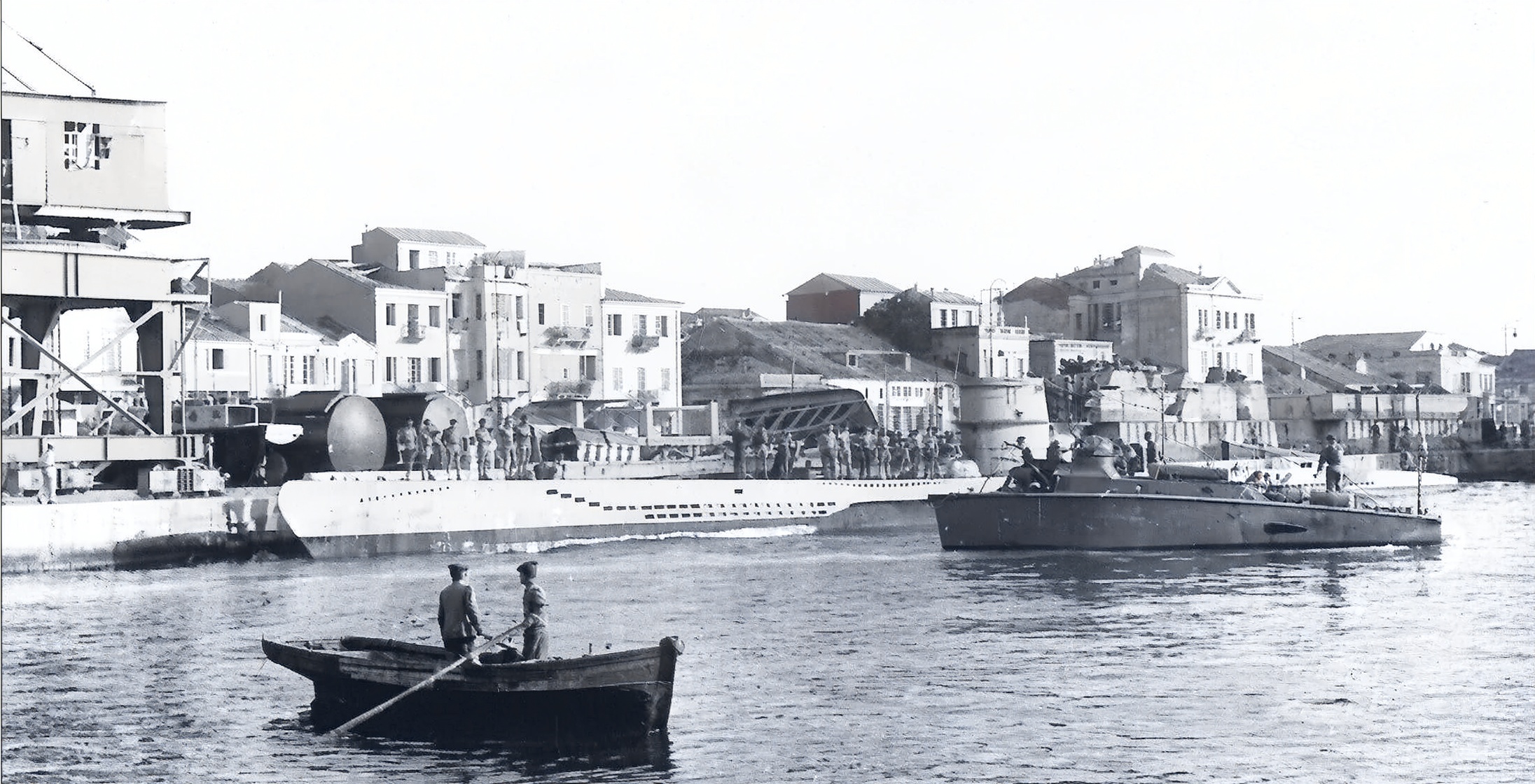
LS 6 departed the port of Preveza on 23 September 1943 as part of a German convoy operating under the 21st U-Jagdflottille (21st Submarine Hunter Flotilla). The convoy consisted of four German landing craft of the MFP type (F 131, F 327, F 331 and F 496), two R-boats (R 194 and R 195), and the escort vessel UJ-2105.
The mission was to disarm Italian garrisons in the Ionian and Epirus regions following the Italian armistice, an operation that eventually led to the German occupation of Corfu.
Between 24 and 25 September 1943, the convoy came under heavy air attack at Igoumenitsa by RAF Bristol Beaufighter aircraft or Regianne bombers and Macchi fighters of Regia Aeronautica.
Two landing craft were damaged, while LS 6 suffered severe damage from nearby explosions. The vessel lost its ability to manoeuvre and became immobilized.
Its lightweight aluminium hull, while providing speed and agility, lacked the structural strength required to absorb such violent impacts. The decision was made to tow LS 6 to Piraeus for repairs, with the task undertaken by the minesweeper R-194, assisted by the landing craft F 331.
During the tow, the cracks caused by bomb fragments continued to worsen under the mechanical stress of being pulled through the water. Water rapidly entered the hull, and LS 6 eventually lost all buoyancy.
The small German fast craft sank in deep water off Preveza, near Mytikas.
Ironically, the vessel that attempted to save LS 6, R-194, would later share a similar fate. On 29 February 1944, it was sunk in the Ionian Sea after being attacked by Allied aircraft of the RAF.
The wreck of R-194 was eventually located in 2015 by the wreckdiving.gr team and identified at a depth of 56 meters.
—
Technical Specifications — LS 6
Builder: Dornier Werft, Friedrichshafen
completed and commissioned: 15 October 1941
Construction material: Aluminium
Displacement:
– Standard: 11.5 tons
– Full load: 11.9 tons
Dimensions:
– Length: 12.50 m
– Beam: 3.46 m
– Draft: 0.77 / 1.02 m
Propulsion:
Two Junkers Jumo 205M diesel engines
1,400 horsepower each
Maximum speed:
37 knots
Fuel capacity:
0.85 tons of diesel fuel
Range:
170 nautical miles at 37 knots
Armament:
– Two 450 mm torpedo tubes
– One 20 mm MG 151/20 cannon
Crew:
7 men
Commander:
Obersteuermann (Ob.Strm.) Klima
(Information provided by Reinhard Kramer)
- Epilogue
A message received in 2013, the dedicated research of our historian George Karelas, and the vision of the AegeanTec diving team have brought the story of LS 6 back into the light.
This discovery does more than reveal another chapter of the Second World War beneath the Greek seas. It contributes to the effort to highlight Greece’s underwater cultural heritage and strengthens the country’s position as a destination for technical divers from around the world.
This potential must become a conscious national choice. The competition from neighboring countries is intense, but Greece possesses a unique advantage: a vast and extraordinary underwater history waiting to be discovered.
The opportunity is here—and it must be embraced.